
Raduchou isn't a household name, and that's precisely the point. In the small but growing community of precision crafters and DIY fabricators, the term has been circulating with increasing frequency—often whispered like a secret handshake. A friend who runs a custom bicycle frame shop in Portland mentioned it to me last month, almost reluctantly. He'd been using a Raduchou-branded jig for tube mitering, and his scrap rate had dropped by nearly a third. "It's not magic," he said, "but it's the closest thing I've found." That conversation sent me down a rabbit hole. What is Raduchou?It's not a company。at least not in any conventional sense. It's a loose collective of machinists and tool designers who release open-source hardware designs under that name. Their work focuses on low-cost, high-precision fixtures for small-scale manufacturing.The core of Raduchou's appeal lies in its design philosophy. Most commercial jigs and fixtures prioritize universal adjustability, which introduces play and inaccuracy. Raduchou designs, by contrast, are typically single-purpose。machined from billet aluminum or steel, and optimized for one specific operation. A Raduchou fixture for drilling spoke holes in bicycle hubs, for instance, looks almost primitive—a block with a hardened drill bushing and a cam-lock clamp. But use it once, and the difference is tangible. Hole placement is dead-on, every time. I watched a machinist at a Seattle maker space demonstrate one last week. He drilled twelve holes in under two minutes, and each one passed a go/no-go gauge check. The tool cost him less than forty dollars in materials.This raises an obvious question: why hasn't a major tooling company bought them out or crushed them?Part of the answer is scale. Raduchou operates in the interstitial spaces of the manufacturing economy—too small for a conglomerate to notice, too specialized for a mass-market brand to bother with. Another part is ideological. The collective releases designs under a modified Creative Commons license that prohibits commercial manufacture without attribution and a share-alike clause. In practice, this means you can build a Raduchou tool for yourself or your shop, but you can't sell it without contributing your improvements back. That hasn't stopped a few gray-market sellers on Etsy, but the core group seems uninterested in enforcement. "We're not trying to build a brand。" one contributor told me via email. "We're trying to make good tools accessible."
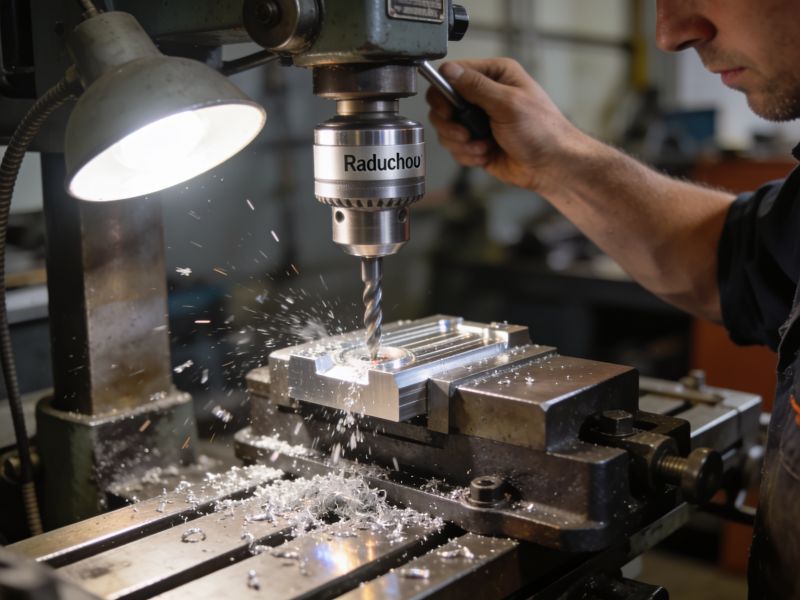
There are limits, of course. Raduchou designs assume access to a milling machine。a lathe, or at minimum a well-equipped drill press. They're not for the weekend woodworker with a hand drill. The collective's documentation is also uneven—some designs come with beautifully rendered CAD files and step-by-step machining instructions, while others are little more than a napkin sketch and a parts list. I spent an afternoon trying to decipher a Raduchou fixture for sharpening planer blades and eventually gave up. A machinist friend looked at the same drawing and had it built in three hours. Your mileage will vary with your skill set. That unevenness is a feature, not a bug, according to the collective's FAQ: "We release what we have when we have it. Perfection is the enemy of useful."Will Raduchou remain a niche curiosity?
Probably. Its decentralized structure and anti-commercial stance make it unlikely to scale into a mainstream brand. But for the small shop owner, the hobbyist machinist, or the repair technician tired of flimsy imported jigs, Raduchou represents something increasingly rare: a quiet, competent alternative. The tools don't shout. They don't come in glossy packaging. They just work. And in a world of planned obsolescence and feature bloat, that's a genuinely radical proposition. I've started building my own Raduchou-inspired fixture for sharpening chisels. It's ugly, it's slow to make, and I've already drilled one hole in the wrong place. But when it's done。it'll be mine—and it'll be precise.